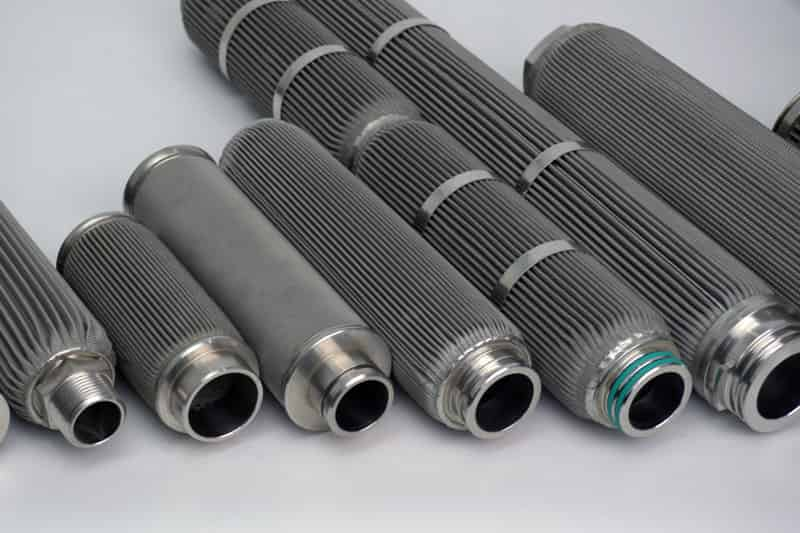
In today's rapidly advancing material science and industrial technology landscape, sintered metal mesh has emerged as a breakthrough innovation in the filtration industry. With its unique material structure and advanced manufacturing techniques, this material overcomes the inherent limitations of traditional woven metal mesh while achieving a significant leap in filtration performance. It provides revolutionary solutions for critical industrial applications such as lithium battery production and high-temperature gas purification.
1. Material Structure and Process Innovation: Reshaping the Mechanical Properties of Filtration Materials The manufacturing process of sintered metal mesh is a masterpiece in material science. It begins with stacking multiple layers of woven metal mesh, followed by high-temperature sintering in a vacuum environment. This process not only endows the material with exceptional mechanical strength but also forms an integrated rigid structure, ensuring the stability of the filtration layers under complex working conditions.
Another key advantage of sintered metal mesh is its precisely engineered pore structure. By carefully controlling sintering parameters, the pores interlace to create a uniform filtration layer. This design not only increases the effective filtration area but also allows for precise control over pore size distribution. Compared to traditional metal mesh, sintered mesh offers more uniform porosity, significantly improving filtration efficiency while preventing filter failure caused by pore deformation.
2. Breakthroughs in Filtration Performance: Surpassing Traditional Filtration Technologies 1. High-Precision Filtration: Capturing Micron-Sized Particles The core strength of sintered metal mesh lies in its outstanding filtration precision. Thanks to its sophisticated pore structure and material properties, it can effectively capture particles as small as 0.01μm. This capability is particularly critical in lithium battery production, where impurities in electrode slurry can severely impact battery performance. By ensuring the purity of the slurry, sintered mesh helps reduce the risk of internal short circuits and enhances both discharge performance and battery cycle life.
2. High-Temperature and Corrosion Resistance: Withstanding Extreme Environments High temperatures and corrosive environments pose major challenges in industrial filtration. Sintered metal mesh, with its superior material properties, exhibits excellent environmental adaptability. In high-temperature gas purification applications—such as fluidized bed exhaust treatment in the petrochemical industry—it operates reliably over extended periods, effectively removing harmful gases and particulates. In corrosive environments, such as filtration of electrolyte-contacting components, its corrosion resistance ensures long-term equipment reliability.
. Long Service Life and Maintainability: Reducing Operational Costs Durability is another key economic advantage of sintered metal mesh. Blocked pores can be restored through backflushing or chemical cleaning, extending the service life of filtration systems. This maintainability reduces filter replacement frequency and minimizes downtime, delivering significant cost savings for industrial enterprises.
. Expanding Application Scenarios: Empowering Diverse Industrial Sectors The advanced properties of sintered metal mesh make it highly valuable across multiple industrial sectors. In lithium battery production, it has become the preferred material for electrode slurry filtration. In petrochemical and metallurgical industries, it plays a crucial role in high-temperature gas purification and catalyst recovery. In pharmaceutical and bioenergy industries, its ability to meet GMP standards for high-purity filtration has made it highly sought after. With ongoing technological advancements, its applications continue to expand into new areas, such as gas purification in long-duration energy storage systems and industrial exhaust treatment.